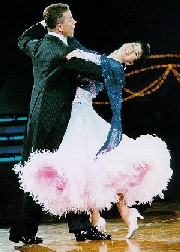
The forerunner of waltz was Boston, dance imported from
USA and introduced in England by a very influential "Boston Club" around 1874.
However, only after 1922 did this dance become as
fashionable as the Tango. The strange thing about Boston was that
couples danced next to each other, nothing like what we do now.
Immediately after World War I the Waltz got more shape. In 1921 it was
decided that the basic movement should be: step, step, close. When in 1922
Victor Sylvester won the championship, English waltz programme consisted
of not more than a right turn, a left turn and change of direction (Less
than what is learnt by a beginner nowadays). In 1926/1927 the waltz was
improved considerably. The basic movement was changed into step-side-close.
As a result of this, many more variations became possible.
They have been standardised by the Imperial Society of Teachers of Dancing
(ISTD). Many of them are still danced. The syllabus is:
|